
Intervals 101
Sounds Good in Theory #1
I have spent a decent bit of time thinking (and occasionally debating with my wife) about the order of Sounds Good in Theory posts. The reason being, I want this series to be as smooth as possible in terms of one thing following on to another. Which of course begs the question, what thing comes first? What is the one thing that, without it, nothing else would quite make sense?
One of the most important things in music is harmony. Another is melody. Both effectively deal with the distance between notes, which is measured in intervals.
Without intervals, you cannot make scales. Without scales, you cannot have a key, any chords, or anything like a melody. So, to me at least, it makes sense that the first ever post on this fledgling series is to do with intervals.
What you will need for this post:
A piano or guitar to play the reference intervals and practice finding intervals from other notes. (If you don’t have these, GarageBand or some other online solution will do.)1
Part 1: The Two Intervals You Actually Genuinely Need.
Because, realistically, everything else basically hinges on these two.
First, take your piano and play any note, then find the very next available note (white or black) and play that.
Or, if you are a guitarist, play any open string and then put your finger on the first fret of that string.
That is a semitone, the smallest conventionally used interval in Western music.2 They are also known as half-steps in some parts of the world, specifically the US. There are twelve of these between a note and the next one of that same type (i.e. between one C and another C.
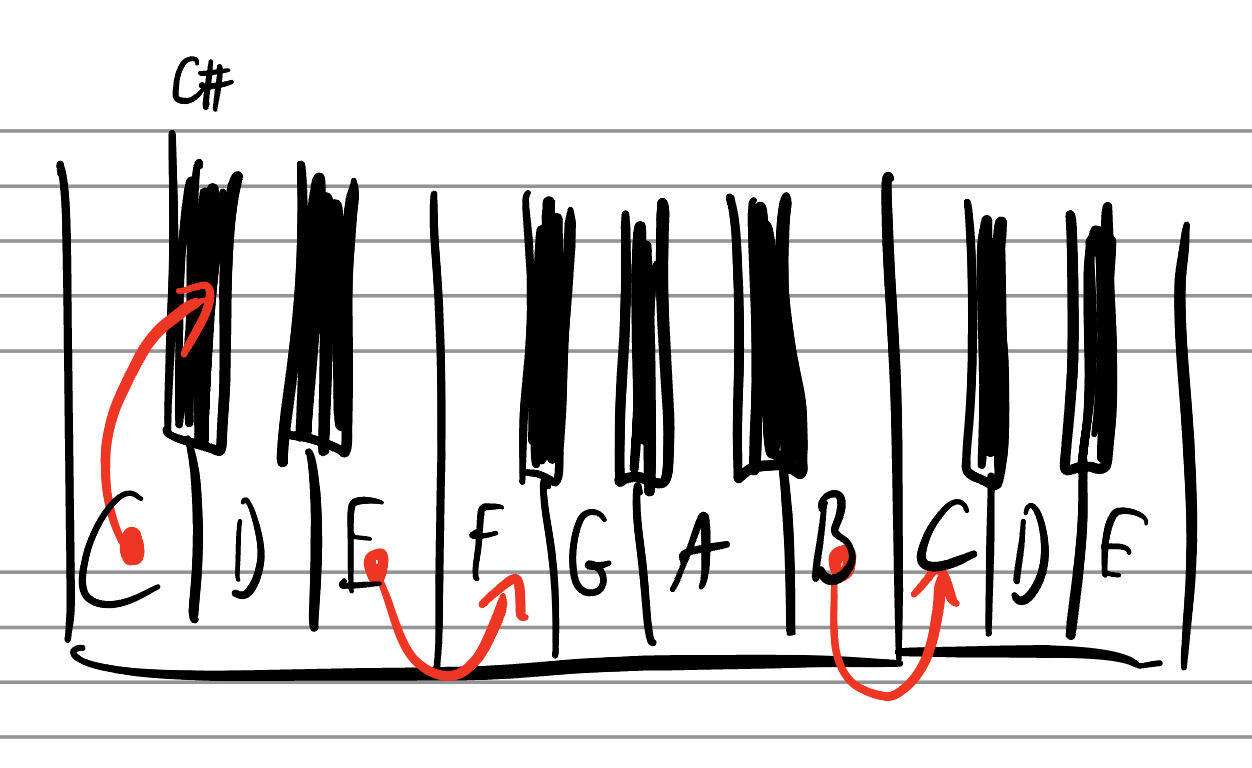
If you go up one semitone and then another, you get a tone, which sounds a little nicer.
Most of the time, when you go from one white note to the next one up, that interval is a tone (except for E-F and B-C, which are semitones). On a guitar, if you start at one note and move two frets up on the same string, that interval is always a tone. (Guitarists have it easy where intervals are concerned, since one fret’s distance on the same string is always one semitone.)
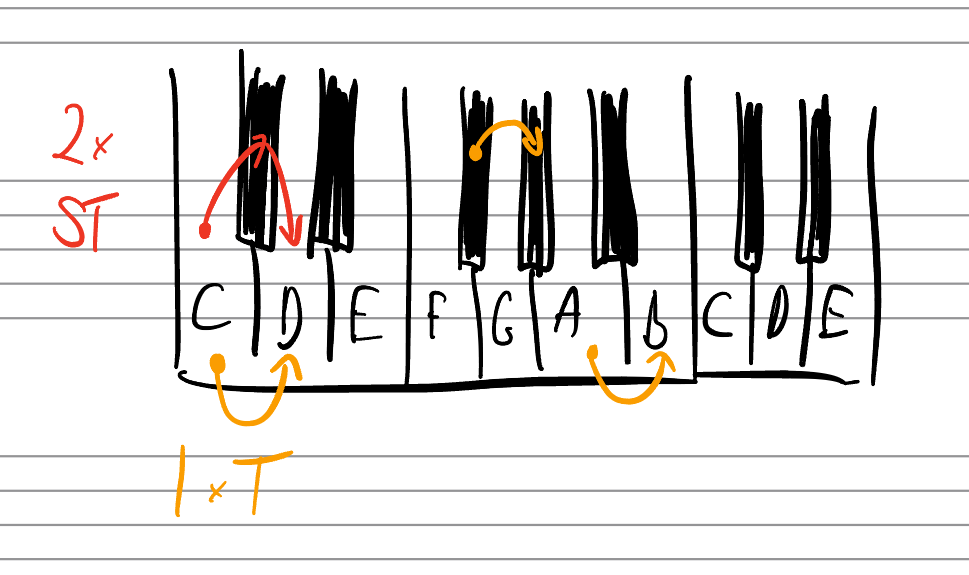
These two intervals are essential for making scales, which can then let you figure out keys, and the chords that match that key. All scales are essentially based on patterns of tones and semitones, which you can follow from any note to make the scale based on it. (More on this in a future Sounds Good in Theory…)
If a melody mostly moves in tones and semitones, it is quite easy to sing or play, since you have to worry less about note positioning. Melodies like this are called stepwise, since they move in either whole or half steps. One fairly famous example of a stepwise melody is Beethoven’s Ode to Joy, which has only four intervals greater than a whole step in the entire main theme.
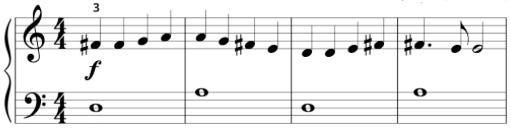
You can also call that melody conjunct if you’re feeling fancy.3
Part 2: Other Intervals, which are Decadent and Frivolous.
Given that there are twelve different notes between one note and the next one of that type, there are quite a few more intervals to cover.
The Minor Third
Distance: Three semitones, or a tone plus a semitone. (C–>Eb)
Use: Very common in rock basslines, as it can sound quite powerful on a low rhythm guitar or bass guitar. Muse’s Supermassive Black Hole is a good example of a repeated minor third (E-G).
How it feels: like trying to walk up a ladder with a weight vest on.4
The Major Third
Distance: Two tones, or four semitones. (C–>E)
Use: Usually at the starts of major-key songs, to help establish the key – the reason major chords are called major chords is because of the major third between the bottom and middle notes. (Likewise with minor thirds, actually.)
How it feels: Calm and stable.
The Perfect Fourth
Distance: Two and a half tones, or five semitones. (C–>F)
Use: The perfect fourth (along with the perfect fifth) is the main kind of interval that marks a perfect cadence – in C major, for instance, going up from G to C feels like it closes the phrase. This makes it good for the openings of film scores such as the Star Wars theme – it establishes the key very well, and the upward motion gives the theme a brightness that befits the movie.
(Also, the whistled interval in Ennio Morricone’s iconic score for The Good, the Bad and the Ugly is a perfect fourth – A to D and back again.)
How it feels: Heroic, triumphant.
The Tritone
Distance: Three tones, surprisingly, or six semitones. (C–>F#)
Use: This is the central tension in a dominant seventh chord – for instance, the chord of C dominant seventh has the notes C, E, G, and Bb, with a tritone between E and Bb. This tension traditionally resolves to a major third, with the lower note moving up a semitone and the higher note moving down a semitone. (C dominant seventh, for instance, resolves to F major (or D minor.)
How it feels: Unsettling, but in the right context, very forward-moving and lively (think The Simpsons theme tune or Maria from West Side Story)
The Perfect Fifth
Distance: Seven semitones, or three and a half tones. (C–>G)
Use: Various. The famous Last Post bugle call opens with an ascending fifth, and there is also a prominent fifth in the Star Wars theme. The opening to Can’t Help Falling in Love also starts with a fifth, which gives it a nice easy-going feel.
How it feels: Simple, pure, and clear.
The Minor Sixth
Distance: Eight semitones, four tones, or a fifth plus a semitone.5 (C–>Ab)
Use: Depends a lot on prevailing harmony – either used to go from the middle note of a major chord to the note an octave above the bottom (The Entertainer by Scott Joplin), or from the top note of a minor chord to the note an octave above the third (Lacrimosa from Verdi’s Requiem, specifically between “la” and “mo”.
How it feels: As above, depends a lot on prevailing harmony – either upward-straining (We Are Young by Fun, “so let’s set the world on fire) or slightly claustrophobic (Yeah by Usher).
The Major Sixth
Distance: Nine semitones, or a fifth plus a tone. (C–>A)
Use: Generally in pastoral contexts, melodies might start on the root note and then go as high as a major sixth above and then back down – the Christmas song In dulci jubilo or Beethoven’s 6th Symphony, movement 1 (Pastoral) are good examples of this.
How it feels: Sunny, in a sort of emotional way.
The Minor Seventh
Distance: Ten semitones, or an octave minus a tone. (C–>Bb)
Use: The interval between the bottom and top notes of a dominant seventh chord is a minor seventh, so it is generally used in that chord – There’s A Place For Us from West Side Story is the quintessential example of this.
How it feels: Poignant and reflective.
The Major Seventh
Distance: Eleven semitones, or an octave minus a semitone. (C–>B)
Use: In practice it often ends up feeling like not-quite-an-octave, so it creates an expectation of upward movement. Consider the main melody from Take On Me by A-ha, specifically between “take” and “on”. (Incidentally, both “take–>me” and “I’ll–>be” are perfect fifths.)
How it feels: Shimmery, ephemeral, and tending upwards.
The Octave
Distance: Twelve semitones, six tones, or the distance from one note to another of the same type (C–>C)
Use: If you want to quickly go from low to high without making it obvious – e.g. Somewhere Over the Rainbow or Party Rock Anthem by LMFAO.
How it feels: Smooth, like accelerating on a highway and realising you’ve just reached 100kph without really trying.
Have a go!
Pick any random note and any random interval and see if you can find the interval above that note. Repeat until it becomes a little more familiar.
Here’s a random generator I just made to help with this.
This has been the first instalment of Sounds Good in Theory – stay tuned for the next post on scales and keys!
–Sam
N.B. this post series assumes some familiarity with naming notes.
I say “conventionally used” because there are some musical traditions which use notes between these (called microtones) and some contemporary composers who are inspired by these and also use them.
The opposite of this is “disjunct.”
These are entirely subjective – once you learn to hear them in songs you can form your own interpretations of how these feel.
At a certain point it becomes easier to think of intervals as “fifth plus something” or “octave minus something” – saves you having to count semitones all the time.
This was a great start Sam! I remember very little music theory from when I was a kid, so I’m looking forward to lots of great learning in this series!