
Scales and Keys
Sounds Good in Theory #2

Welcome back folks!
In the last instalment of Sounds Good in Theory, I introduced the concept of intervals – the building-blocks of every scale and chord. You can read this here:

I also hinted there that the next post that I would do would be on scales and keys, and I am a man of my word, so let’s get straight into it.
What you will need for this post:
A piano, or at least a picture of one.
Part 1: The Two (And A Half) Scales You Actually Need.
Generally speaking, most music that we are familiar with in the West uses one of two scales: major or minor. These two scales are made up of different patterns of tones and semitones, which we can figure out fairly easily using a piano, or a picture of one.
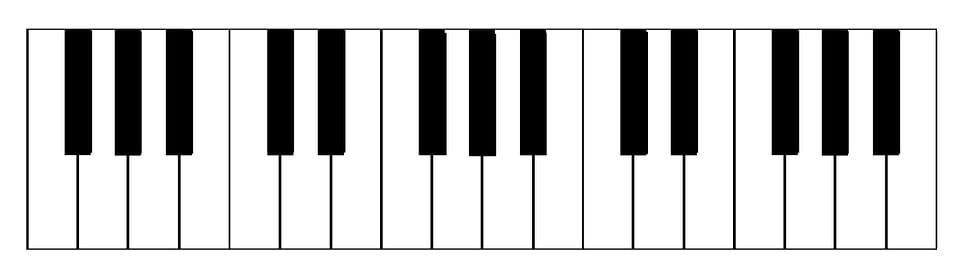
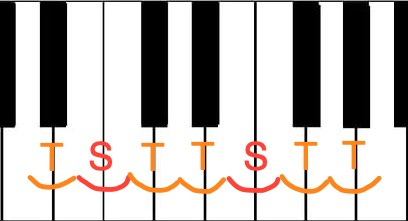
If you find a C (immediately to the left of the two black notes) and follow all the white notes up to the next C, you get this pattern of intervals (S=semitone, T=tone):
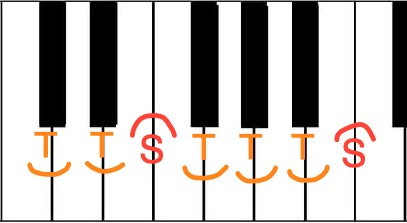
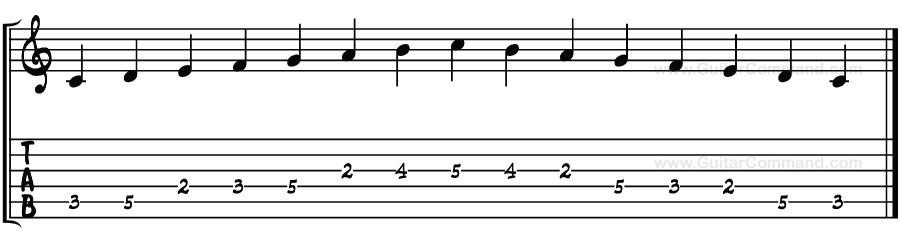
From the starting C, you go up two tones, then a semitone, then three tones, and another semitone. This pattern of intervals makes the C major scale. Here is the guitar tab for the guitarists amongst you:
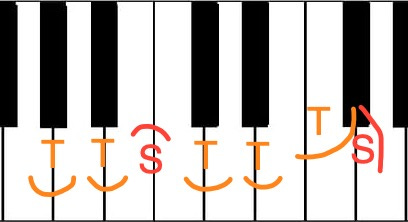
The interesting thing is that if you find a different note – G, for example – and follow this pattern of intervals, then you get this:
Or for the guitarists:
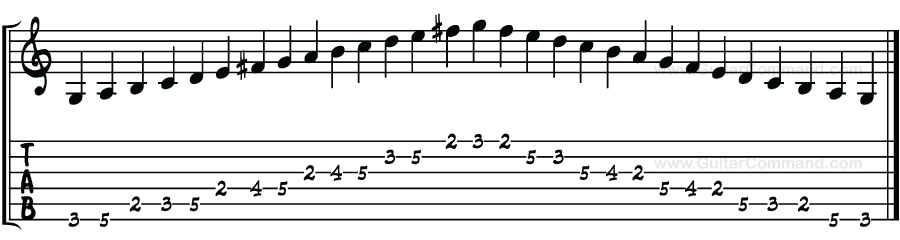
This is the G major scale – you may notice the addition of the black note F#, which is a tone up from E.
In fact, if you start on any note and follow this pattern of intervals, you get that note’s major scale. Here is Eb, for instance:

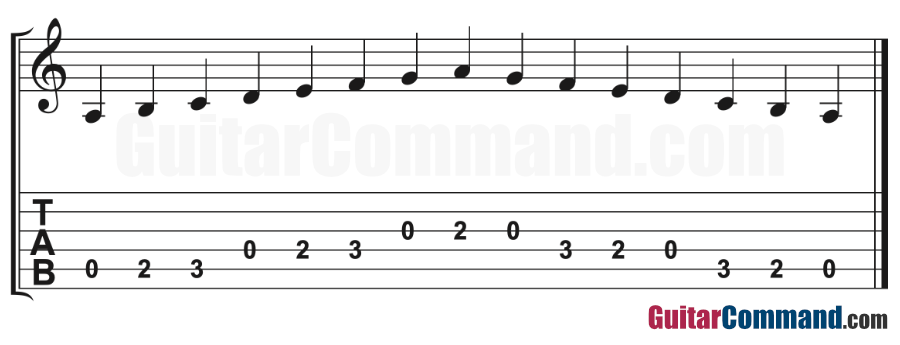
The other main scale that gets used is the minor scale – this is what happens if you take all the white notes from A to A and apply that interval pattern to other notes.
Or for the guitarists:
Wait a second, that’s only two scales – what happened to that half a scale you were talking about?
Oh hello Editor Sam, I wondered when you’d show up again.
So technically this specific scale is called the natural minor scale – this is the scale used by a lot of pop music that is technically in a minor key (I have written about this elsewhere). There is another type of minor scale that is more commonly used when you are trying to write more classically inclined harmonies, which is called (surprise surprise) the harmonic minor scale. It’s basically the same except the note below the top one is a semitone higher than in the natural minor.
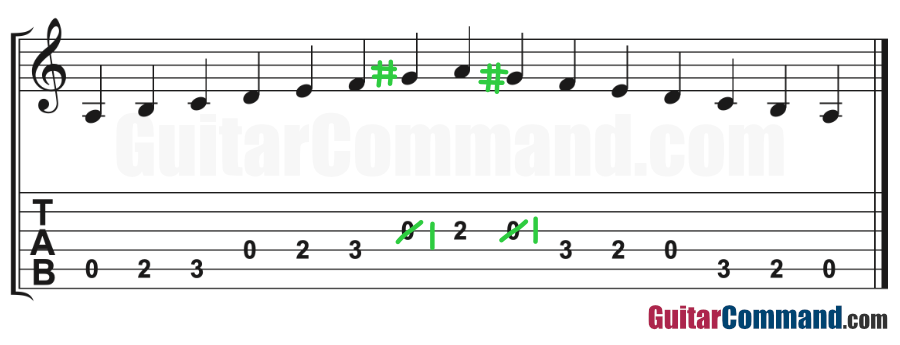
The reason the note goes up is to do with what is known as voice-leading, or the tendency of notes to want to go to other ones. Think of it like magnets: G# is closer to A than G is, so it will attract more and be more satisfying when it gets there. More on this in a future Sounds Good in theory, I’m sure.
There are some pop songs that opt for the harmonic minor over the natural minor. Wandering Star by Portishead, for instance, is in B minor, with the penultimate note raised from an A to an A# to make the F# chords work.
Part 2: Other Scales, which are Decadent and Frivolous.
Okay, technically most of these aren’t scales, they’re modes – for some reason only the major and minor, plus a few others, really get called scales.
The Dorian Mode – T S T T T S T
Follow the white notes from D to D and you get the Dorian – basically a natural minor scale with the sixth note raised a semitone. Sounds very folksy and medieval.
The Phrygian Mode – S T T T S T T
Follow the white notes from E to E. Sounds slightly ominous because of the semitone start, used in film scores to suggest tension and exoticism. My wife says that this one is “not bad.”
The Lydian Mode – T T T S T T S
White notes from F to F – basically a major scale with a raised fourth note. Sounds very bright and shimmery. Great example of this mode in action is the start of the Magnificat from Kenneth Leighton’s Second Service.
The Mixolydian Mode – T T S T T S T
(I suppose because you take the Lydian and Mix it up a little?)
White notes from G to G – basically the major scale with a lowered seventh note. Sounds major in a slightly firmer way. Rachel Portman’s score to the film The Duchess uses this mode in its opening title.
The Locrian Mode – S T T S T T T
White notes from B to B. All hope abandon, ye who enter here. It is basically impossible to write music in this mode since the tonic chord is not a major or a minor chord, but a diminished chord, which has in it the inherently unstable tritone. (For more information about how chords work in context, stay tuned for a future Sounds Good in Theory.)
This mode is essentially the musical equivalent of this image:

(Technically the major and minor scales also have mode names; they are the Ionian and Aeolian respectively.)
The Whole-Tone Scale – T T T T T T
A favourite of harp players and Claude Debussy. As the name suggests, you pick a note and keep going up in tones. If you’ve ever heard that stereotypical harp sound when a character starts daydreaming, chances are that was a whole-tone scale – they generally sound slightly surreal and ungrounded.
The Chromatic Scale – S S S S S S S S S S S S
Just play every note from one C to the next C. Sounds a little like you’re rolling down a hill if you play it downwards.
The Octatonic Scale – either T S T S T S T S or S T S T S T S T
So called because there are eight separate notes in it, as opposed to the regular 7. A favourite of twentieth-century composers like Stravinsky, Bartók and Radiohead.
The Pentatonic Scales, Major and Minor
Basically the corresponding scale with all the semitones taken out (the technical term for this is anhemitonic, meaning “having no semitones”). A C major pentatonic scale, for instance, cuts out the E-F and B-C semitones, leaving C D E G A C, while an A minor pentatonic scale does the same to give A C D E G A. Often used by beginner guitar students to noodle around during solos.
The Blues Scales
If you take a major pentatonic scale and add in the note between the second and third notes, you get the major blues scale – that added note is called the “blue note”. The C major blues scale, for instance, would be C D Eb E G A C.
The minor blues scale, in the same way, is the minor pentatonic scale with an added “blue note” between notes 3 and 4, so A minor blues would be A C D Eb E G A.
There are many other types of scale in the world, like the ragas of India and the maqamat of the Middle East, as well as the slendro and pelog scales of Gamelan music, which for the sake of length I won’t go into here but will leave with you, dear readers, as a stepping-stone to further scale exploring.
Part 3: Key Signatures
Once you have written your scale, you may notice that some of the notes have sharp or flat signs next to them. What people tend to do to make their lives easier, and avoid having to write out the sharp and flat signs every time they write that note, is shove them all to the left hand side where the clef is. Take this E flat major scale from earlier:
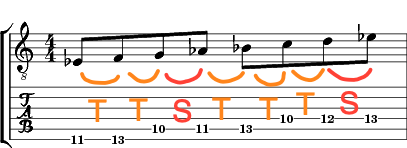
What you can do is take the Ab, Bb and Eb and stick them all on the left, like so:
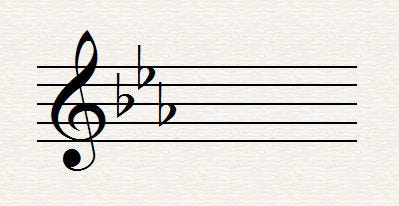
What this means is that every time you see an E, A or B written on the score, what you are meant to do is play an Eb, Ab or Bb, because those are the black notes that are in the Eb major scale. So, keys (and chords) come from scales, scales come from intervals, and intervals come from notes.
N.B. This won’t work on anything that isn’t major, minor, or one of the modes listed in Part 2 – you can’t say something is in the key of Octatonic Scale, you would say that it is in the key of wherever your octatonic scale starts.
If you want to practice making scales, or at least naming the notes in them, I have made another random generator to help you. You can use this and the interval patterns in this post to test your understanding.
Next time: a breakdown of how to make chords, and how notes and chords tend to behave within keys – concepts known to music analysts as functional harmony and voice-leading.
Till next time!
–Sam